
Porchetta
The key to crispy, crunchy crackling is having a dry rind, before cooking the pork. Try to purchase your piece of meat a couple days in advance of when you want to cook it, at least 2, but up to 4 is good too. I find that when buying from a local butcher versus a big grocery store, the butcher meat tends to be drier as its probably been hanging in a cool room and not wrapped in shrink wrap with all its juices circulating and making the rind wet. This just helps speed things up and you may not require an extra day of drying. I would also always encourage you to try and buy from a small local business and especially one that sources meat from ethical farms. It will always taste better.
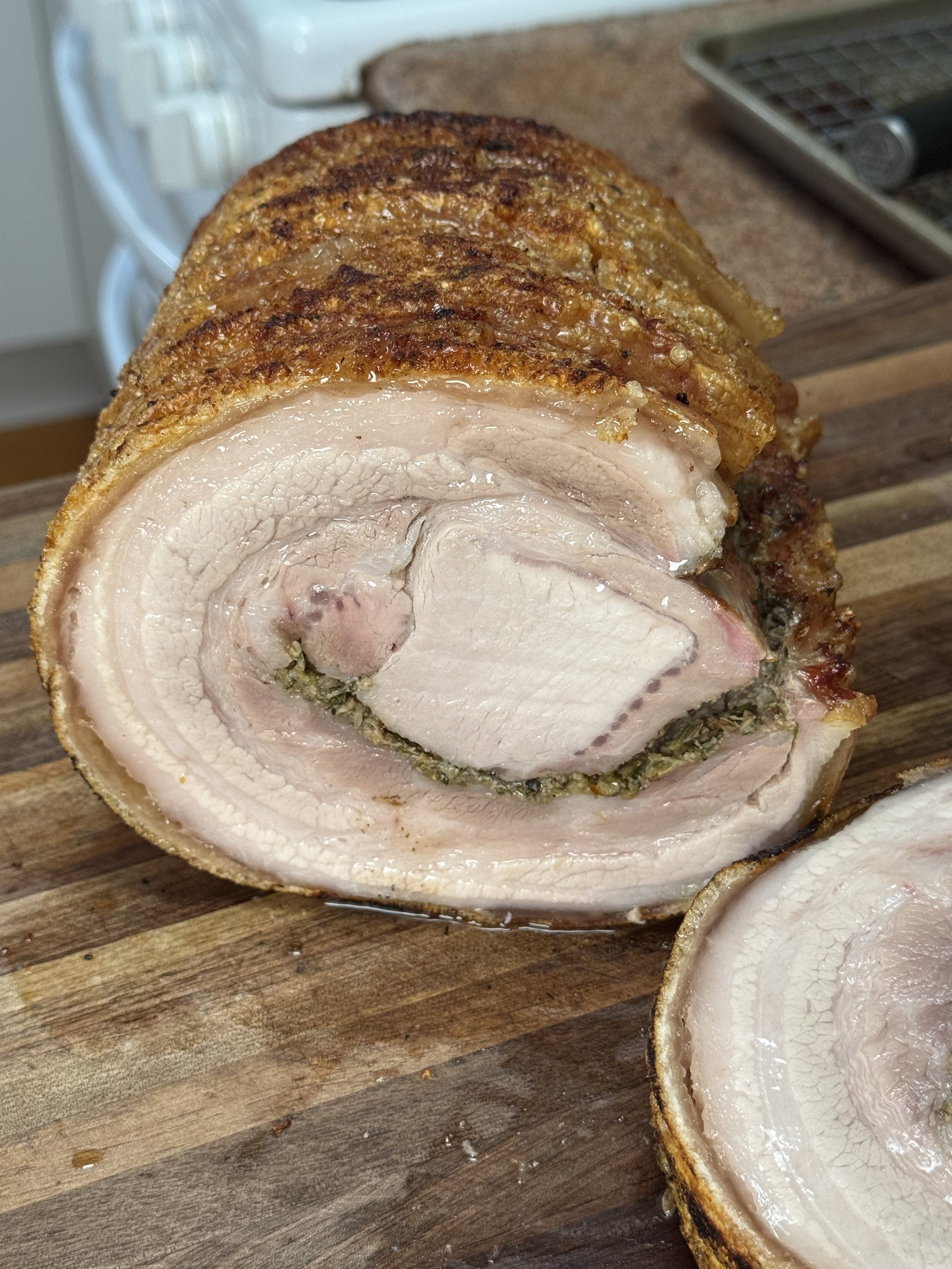
Serves 10-12
Ingredients:
2kg boneless pork loin with belly attached and rind on
Salt and black pepper
Herb and garlic paste:
6-8 cloves of fresh garlic, peeled
5-6 stems rosemary, leaves stripped
¼ cup chopped sage leaves
Zest of 1 lemon
Pinch of chili flakes
2 Tbls. fennel seeds
Note: you do need a meat thermometer to accurately know when it is cooked through. You will also require butchers string to tie up the roast. You can ask your butcher nicely for a piece, if you don’t have any.
Method:
Remove the pork from any packaging and dry it well. Place it on a baking paper lined tray and leave it uncovered in your fridge overnight. The following day, use a sharp pairing knife or box cutter and score the rind in thin strips from loin to belly. Cut through the rind and fat but try not to cut into the meat at all. Do this very carefully and with some strength on a good steady board or countertop so your meat doesn’t slide around. The drier the rind, the more difficult to score it. If this worries you, you can also just stab the rind (many, many times) all over with the tip of a pairing knife or a sharp skewer. It achieves the same goal of creating lots of places for the fat to render out and fry the rind.
Make a herb paste by crushing those ingredients together in a mortar and pestle or use a small food processor. Rub that paste all over the meat side of the pork from end to end. Season the meat with salt and lots of black pepper.
Roll the loin inwards so the belly wraps around it. You may want to cut off a piece of the belly at the very end (leaving rind on, though) so the belly easily wraps around the pork in one circle as opposed to overlapping. Use butchers string and at 3cm intervals, tie it tight. No need for fancy butchers knot. A simple double knot will hold just fine.
If your rind is quite dry, rub a few teaspoons of any oil on it and then season liberally with salt. This just allows the salt to stick. If it still had a bit of moisture, the salt will naturally stick without the need for oil and will help to pull that moisture out. Return it to your baking paper lined tray and leave it, uncovered in the fridge for one more night.
The following day, remove it from your fridge, an hour or two before you want to begin cooking it so it begins to warm to room temperature. Place it on a rack, over a baking tray and preheat your oven to 240C conventional (220C fan-forced).
Place the pork in the center of the oven and roast at this high temperature for 30 minutes. After 30 minutes, reduce the heat to 150C conventional (130C fan-forced) and keep roasting for 2.5-3 hours until an internal temperature probe tested in the center of the loin reaches 62-65C (143-149F). I would start checking the temperature after 1.5 hours just to see how quickly it is cooking. Ovens can vary grately.
Once it reaches this temperature, remove it from your oven carefully and turn on your broiler function of your oven. Some ovens have this in a separate compartment. Either way, turn it on to high. Move the rack up to be closer to the heat source, if this applies to your set up. Return the pork to the oven and DO NOT WALK AWAY from it. Keep your eye on it as this happen quickly. The intense heat of the broiler will begin to make the rind puff up and blister. This is what you want but it can also burn quite easily. If you have a little patch that burns a tiny bit, you can scrape it off, just like with toast and no one will be the wiser. It may be a bit messy but I like to roll the pork around a bit so this happens all over the pork and not just on the top.
Once it is blistered all over. Remove it from the oven and allow it to rest for at least 30 minutes before slicing and serving with your desired accompaniments.
